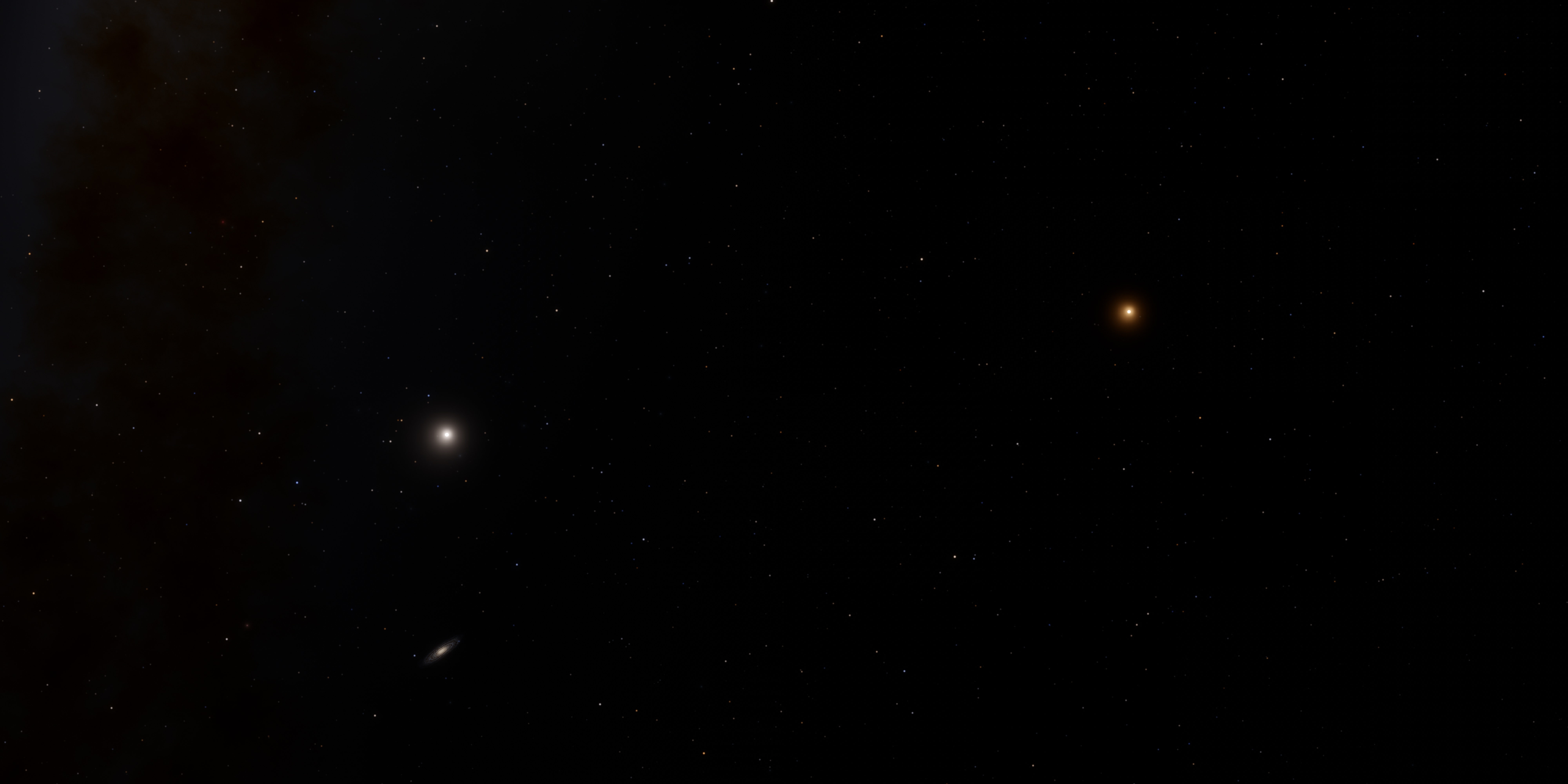
The Hope and Fate system is the system which Aron belongs to. It is a binary star system between Hope and Fate. The system contains a total of 17 planets, 10 orbiting Hope and 7 orbiting Fate, along with numerous dwarf planets and moons.
Hope is a yellow dwarf star and has 10 planets and 7 confirmed dwarf planets as of 2027. Of the 10 planets 6 are rocky planets and 4 are gas giants. These 10 planets, ordered in orbit from the closest to Hope to the farthest, are Astet, Ketal, Sera, Aron, Poree, Cailus, Polion, Scurra, Giras, and Boreas. The 7 dwarf planets are Creonus, Tiecho, Cuenive, Liaka, Setria, Micherinos, and Supaolupao.
Astet and Ketal are a binary pair of similarly sized hot planets, located the closest to Hope at only 0.4 AU. Astet, the smaller of the two, has a diameter of 3943km while Ketal is larger at 4395km. Astet and Ketal have an orbital period of only 91 days, with an extreme orbital inclination of 63 degrees and an irregular eccentricity of about 9 degrees, making it highly unusual compared to the rest of the Hope system.
Astet and Ketal orbit each other very close, with the two only being about 27674km apart. Despite this Astet and Ketal are slowly drifting away from this binary orbit, and will escape each other in roughly 4 billion years. Both planets have very similar environments, with a grey rocky landscape and many craters. However in contrast to Ketal, Astet does have an extremely thin atmosphere, mainly comprised of Octane. This is due to Astet's active core and subsequent volcanic activity which slowly replenishes the atmosphere as solar winds from Hope continuously strip it away, creating a cycle which sustains the thin atmosphere. Ketal does not have any volcanic activity, and likely hasn't for hundreds of millions of years, which is why the planet is completely airless.
Sera is a hot, arid planet and the second closest to Hope at a distance about 0.75 AU. It is a mid-sized planet with a diameter of 9615km. Despite being far from the largest planet in the Hope system, it is by far the most dense, giving it a gravitational force only slightly less than that of Aron. Sera has an orbital period of 238 days, and almost no orbital eccentricity or inclination to speak of. The environment of Sera consists mainly of endless hot wastelands and canyons. The daytime side of the planet can get as hot as 172 degrees celcius. The nighttime side is not much better, with the lowest temperatures still being around 80 degrees celcius.
The many canyons of Sera, such as the impressive Mera Ciralaro, can stretch hundreds of kilometers and are easily visible from space. The planet is still somewhat geologically active, with sparse volcanic activity and clear signs of changing terrain. This is seen nowhere better than the divide between two sections of the planet, Sero Entrus and Sero Kihnui. Sero Entrus is a darker, heavily cratered and mountainous section of the planet while Sero Kihnui, is a lighter section untouched by craters, showing that it has changed due to geologic activity over time, mainly due to volcanoes. However on a cosmic scale this geological activity is short lived, as astronomers predict that the core of Sera will fully become inactive within the next 50-100 million years
Sera also contains a somewhat thin atmosphere mainly composed of water vapor which makes up 76.5% of the atmosphere, although the atmosphere also contains substantial amounts of compounds such as ammonia and carbon dioxide. With a pressure of 0.01447 atm Sera's atmosphere is roughly 2.5% as thick as Aron's at sea level. This is not much, however it is thick enough to give the planet its iconic yellow-orange glow, where in reality the planet is mainly grey rock with light yellow accents of sulfur. This atmosphere, due to Sera's failing core, will likely be slowly stripped away by solar winds when the geological activity ends and its replenishment stops.
Finally, Sera also has two small moons orbiting it, the asteroids Jularia and Beluria, with a diameter of 12.79km and 17.30km respectively. Despite their small size, these two moons are clearly visible from the surface of Sera, as the orbits of both get very close to the planet. Due to this they can sometimes cause Seran solar eclipses. Unlike on Aron these eclipses do not fully cover Hope, however they do somewhat dim it for short periods of time as the asteroids pass in front of Hope, although it is not by much. Overall Sera is a highly interesting world, and with its diverse environments is one of the most similar planets to Aron in the Hope system, therefore making it an ideal place to search for past life.
Aron is a wet, highly hospitable planet and the home of everything Aronians have ever known. It orbits about 0.99 AU away from Hope and is the second largest rocky planet in the Hope system, with a diameter of 12,251km. It takes roughly 358 days for Aron to orbit Hope and said orbit has very slight inclination and eccentricity. Aron is full of diverse environments, from forests to mountains and deserts, anything can be found. Aron's average temperature is 27 degrees celcius, making it the most livable planet in not just the Hope system, but the entire Hope and Fate system as a whole. The planet has an atmosphere composed of 77.9% nitrogen, 20.9% oxygen, and small percentages of other gases.
Aron is not just unique in its habitability but also its moons. Aron has two moons, Nyx and Parvus, with a diameter of 3470km and 2676km respectively, making them among the largest moons of any non-gas giant planet in the Hope and Fate system.
Nyx is a white-grey essentially airless moon with a large amount of cratering and due to this, freezing temperatures as low as -52 degrees celcius. It orbits an average of 304,412 kilometers away from Aron with limited eccentricity. Nyx likely formed during Aron's earlier formation when it slammed into another protoplanet.
Parvus, in contrast, is a temperate ocean moon. It has a thick atmosphere for its size, triple the pressure of Sera and in some areas up to 10% the thickness of Aron's. This atmosphere consists mainly of carbon dioxide and smaller amounts of propane and nitrogen, giving the moon a distinctive light blue color and an average temperature of 8-9 degrees celsius. Unlike Nyx, Parvus is not heavily cratered, with the only noticeable craters being a few extremely large craters on its surface which form much of the basin for its vast oceans of ammonia mixed with small amounts of Copper (II) Chloride.
These craters, along with Parvus' wildly different chemical composition, orbital eccentricity, and inclination compared to Nyx, suggests that Parvus is not from the Aron system. It is likely that during the formation of the Hope system Parvus was a protoplanet orbiting quickly somewhere around Sera's orbit, and may have grazed Sera, giving Parvus its craters and flinging it outward towards Aron's orbit where it was eventually pulled into a stable orbit around Aron along with Nyx. However it formed, Parvus is a unique part of the Aron system, and on nights where Nyx is not visible, Parvus casts a pale blue glow on Aron.
Poree is a frigid ice planet and the 4th farthest from Hope with an average distance of 1.81 AU from the star. It is a mid-sized planet, having a diameter of 8648.45km, making it the second smallest planet in the Hope system. Poree has very little orbital eccentricity or inclination, however it has a very long orbital period of roughly 889 days. Poree's mass is about 20% of Aron's, this in combination with its size makes Poree much less dense than Aron. Poree's distance from Hope, along with its reflectivity, makes the planet very cold, with an average temperature of roughly -109 degrees celcius.
Poree has a relatively thick atmosphere around 47% as thick as Aron's, having an atm of roughly 0.4745 and mainly composed of Nitrogen. This composition gives the atmosphere a bright white glow from space, however on the ground the sky is a more yellow tint. At the higher latitudes of the planet liquid nitrogen has been observed to rain down in the upper atmosphere, where temperatures can get as low as -225 degrees celcius.
Poree has a wide array of diverse environments, and a noticeable lack of cratering. This is likely due to the shifting nature of the ice sheets and constant cryo-volcano activity, which is also the reason Poree has held onto its atmosphere. Past geological activity, likely from around a billion years ago before the planet's core cooled, has led to the existence of vast mountain ranges and glacier formations across the planet with endless ice sheets between them. Across these ice sheets frigid winds reach an average of 100 kilometers an hour, smoothing the landscape. Due to the planet's low density and abundance of ice it is believed that below the surface is a subsurface ocean hundreds of kilometers deep, which some believe could harbor life fueled by geothermal vents at the bottom.
Poree's defining feature is its rings, a thin belt of rock and ice surrounding the planet, due to the high distance of the rings from Poree, far outside the planet's roche limit, it is believed that these rings are the result of collisions from past asteroid moons of Poree, likely created by the capturing of asteroids flung into the inner Hope system from Cailus. Up to 5 of these moons are thought to have existed before colliding with each other to create the ring system. Currently Poree only has 1 moon, named Paite, a leftover remnant of these past collisions. This moon is a freezing white asteroid, and only has a diameter of slightly over a kilometer. Paite orbits just 6935 km above Poree's surface at its closest, however the moon's orbit has a very high eccentricity and inclination.
Creonus is the first dwarf planet in the Aron system, uniquely situated between the rocky planet Poree and the gas giant Cailus. It is relatively small with a diameter of about 1017 km. It orbits at a distance of roughly 2.64 AU from Hope, and takes 4.38 years to orbit the star. Creonus has an above average orbital inclination and eccentricity, with the inclination being about 8.34 degrees and the eccentricity being about 0.0267. Creonus is an extremely cold planet due to its high orbital distance and complete lack of atmosphere, having temperatures below -200 degrees celcius on the night side, although the day side can reach up to -40 degrees celcius. It is a blueish-grey rocky world, and heavily cratered by billions of years of impacts as Creonus has likely not been geologically active since its formation.
Cailus is the first of four gas giants in the Hope system and it is also the largest of them with a diameter of 139,972 km. The massive planet orbits at a distance of 4.06 AU, with tiny eccentricity and almost no inclination. This distance gives the gas giant an orbital period of about 10.75 years, although despite this it is by far the closest to Hope of the gas giants in the system. The planet is overall a light blue color, with distinctive shades of blues forming the weather systems of its deep atmosphere. Cailus is also the most massive object in the Hope system, having a mass over 340 times that of Aron, although being a gas giant Cailus is not very dense.
Cailus has no physical surface to stand on, and is instead made up of layers upon layers of clouds and atmosphere, mostly composed of hydrogen. These regularly form into huge superstorms, some of which can reach sizes larger than that of other planets and last 100's of years, such as Caili-Surtora, a massive superstorm over 18000km in diameter which forms a deep blue oval on Cailus' surface. Wind speeds inside the planet average around a huge 500 kilometers per hour while areas like Caili-Surtora can reach up to 1000 kilometers an hour. Due to its distance from Hope, Cailus has an average temperature of -220 degrees Celsius. The frozen windy atmosphere of Cailus continues tens of thousands of kilometers down, until around 25,000 kilometers from the core the pressure becomes so intense that the hydrogen atmosphere compresses into a liquid hydrogen ocean, and 10,000-15,000 kilometers deeper lies a roughly Aron sized superheated rocky-metallic core where temperatures reach as high as 30,000 degrees celcius. Due to this internal structure Cailus hosts the largest magnetic field in the Hope system, and an expansive radiation belt which makes living within 1,500,000 kilometers of the planet essentially impossible. The planet's name comes from the Palmarian god of nature Cailus.
However, the most interesting part of Cailus is its 6 major moons, though this does mean that material for the moons is more spread out which means its moons have a lower size than most gas giants in the Hope and Fate system. These moons are split into 2 major catagories. The 3 largest are known as the Megeleian Moons, after Megeleia Galoni, the first recorded astronomer to observe the Cailus moon system. The smaller 3, due to the distance in size between them and the Megeleian Moons, are known as the Siternein Moons, after ancient Phydrian Astronomer Siternei, who wrote the first record of Cailus' existance. The 6 moons, in order of largest to smallest, are as follows: Alneim, Ise, Serendai, Charayl, Monacle, and Kiethe.
Alneim is the largest moon of Cailus and also the closest to the planet, it has a diameter of 5842 kilometers and orbits 771,714 kilometers away from Cailus. Though it may gain some heat from tidal heating, its lack of an atmosphere does not allow that heat to remain trapped for long. The moon has a grey, cratered rocky surface, though the most iconic part of Alneim are the deep blue patches of the moon. These patches are formed due to the moons high amount of azurite, a blue stone found often in copper deposits. This azurite is believed to be consistently resurfaced over millions of years as the gravity of Cailus pulling on Alneim resurfaces the moons geological activity every couple hundred million years and causes the azurite deposits to be visible. Alneim, along with a majority of Cailus' major moon system, was first observed by Megeleia Galoni in 1529 DME. Alneim is named after the Palmarian god Alneim, son of the god Cailus.
Ise is the second largest moon of Cailus, though it is only slightly smaller than Alneim. However in contrast to Alneim, Ise is the farthest major moon from Cailus by far, orbiting at a distance of 2,559,139 kilometers. Ise has a diameter of 5652 kilometers. It is a Blue-White moon with large, dark almost black plains. It has much less cratered surface than Alneim, though there are 5 massive craters on its surface which are an exception to this. These craters form the moon's iconic black lowlands comprised of ancient volcanic material. Ise is the most unqiue moon of Cailus in the fact that it is the only one with a substantial atmosphere, mainly comprised of volcanic Sulfur Dioxide, Nitrogen, and Ethyline. This atmosphere is about 1/50 the pressure of Aron's. The atmosphere is replenished by gases escaping the planet's interior, and has a long lifetime due to the fact that unlike most moons, Ise's core is hot enough to create a magnetic field. Like Alneim, Ise was first discovered in 1529 DME by Megeleia Galoni. Ise is named after the goddess Ise, sister of the god Alneim.
Following Alneim and Ise, the two sibling moons, the size of Cailus' moons drop dramatically. Serendai is a mid sized moon at 3794 kilometers in diameter, and like Ise orbits far out, having an average orbital distance of 2,419,193 kilometers from Cailus.