Enequit Wars
Overview
The Enequit Wars were a series of large and devastating wars which occurred on the continent of Enequit from 1910-1926. Enequit during this time was the most unstable it had ever been. However, Entara, the eventual winner of these wars, would shift the balance of power in Aron for years to come.
Prelude
The conditions which created the Enequit Wars did not occur overnight. Decades of building instability in the region had been slowly priming the powder keg that was Enequit to explode. Events like the 1903 dissolution of Corva-Repsen or the annexation of Nautfranken by Entara in 1886. Conflicts like these, while not directly involved in the Enequit Wars, created the strife between nations necessary for the Enequit Wars to occur. Following the fall of the Corva-Repseni Empire in 1903 Enequit returned to an unsteady peace. This did not last however, as in 1910 the first escalation would begin.
1st Aquitan War
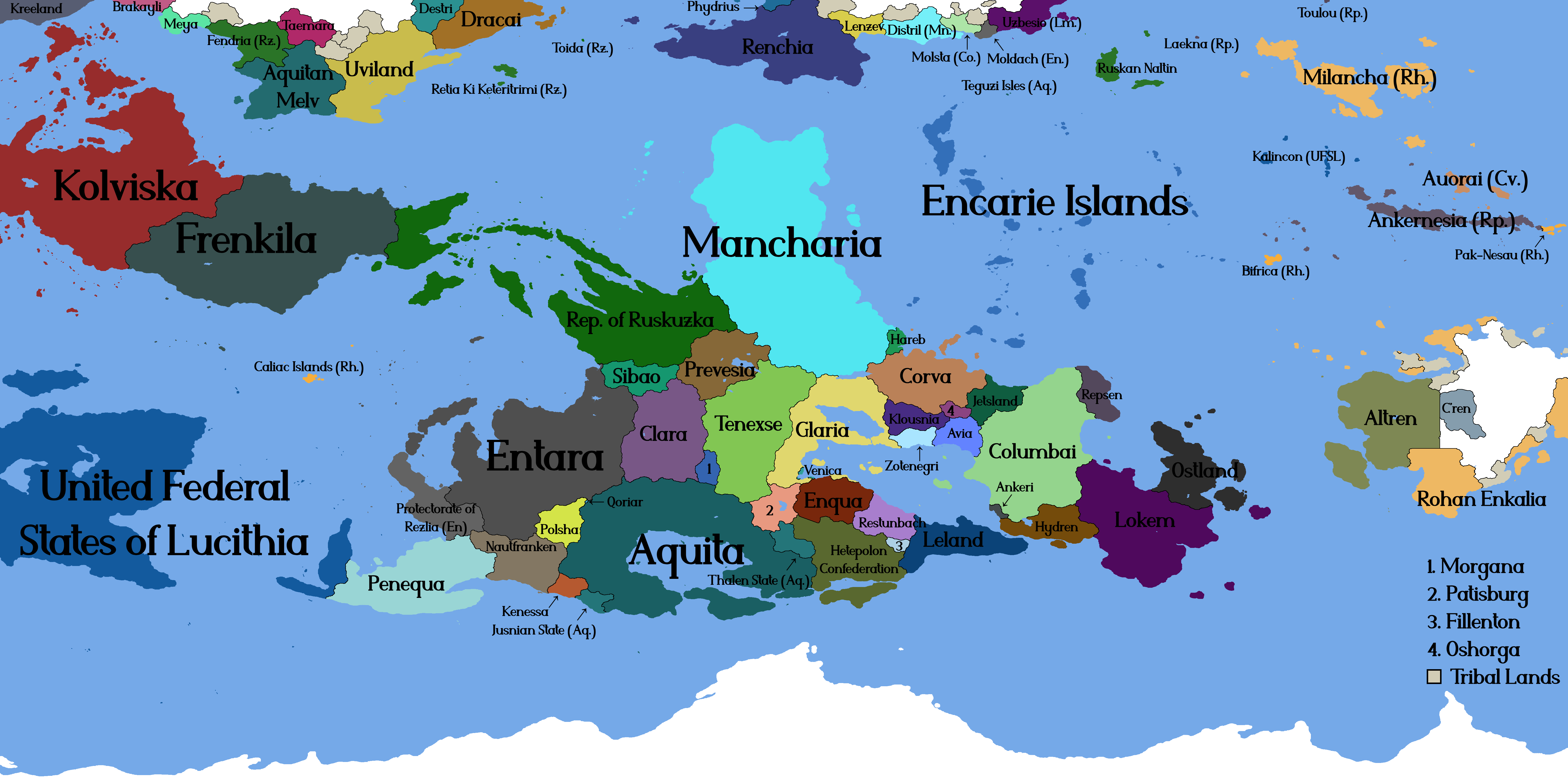
From 1897-1910 Entara would engage in many border skirmishes with the nation of Aquita, a large Southern Enequit power which had been one of the few countries at peace for the last 50 years. In 1902 an Officer corps rebellion would occur in Entara, almost collapsing the government. Although the rebellion was halted by the government, the period of partial civil war was damaging the nation. In 1903 an agreement was reached, the rebellion would disband and the government would escalate the border clashes with Aquita to gain more resources for the Army branch of the military. During the next 7 years government officials would cycle out, slowly getting replaced by more war-oriented ones all while more and more power landed in the hands of the nations Prime Minister. A huge military buildup happened as well and by 1910 Entara was prepared for all out war. In contrast to this Aquita had not done a large amount of military buildup. It had a large military especially due to its size, however Aquita’s greatest strength was on the sea. The ANR (Aquitan Navy of the Republic) was one of the strongest in Aron and held a clear advantage over Entara’s still large, but mostly regional navy. After months of uneventful battles, hell would break loose on one fateful morning: July 24th, 1910.
War Begins
In the morning hours of August 24th without a declaration of war, over 700 thousand Entaren troops, joined with 60 thousand from its ally Polsha, flooded over the border with Aquita, supported by artillery and shore bombardment. The Aquitan military was in a state of shock, as over the last month communications with the Entaran government had been heading towards a diplomatic solution to the border conflicts. Within 24 hours6.0 octants Entaren troops had pushed heavily into Aquita and captured major cities in border provinces.
Over the following week Aquita ordered a full scale mobilization of its armed forces, however as the million strong Aquitan Army mobilized much of the fighting was done by the nation's 100 thousand border troops and its national guard, the L'eguar de Nationou. As Entara continued the invasion its advance began to slow around the major city of Graten, the capital of the province of Richiellou. With the mobilization of Aquitan forces well under way by this point the siege of Graten took over a month to complete, placing heavy strain on the Entaren supply lines and forcing the overall movement of the front to a crawl. Graten was eventually captured and the advance continued, but by now Aquitan troops were numerous and well dug in causing the front to stabilize as snow began to fall over Aquita.
As winter set in, Entara started a few offensive operations, notably capturing the city of Louvere, a major Aquitan industrial hub. Progress was slow however, and support for the war was already beginning to wane in Entara, as the government had prioritized its military over improvements in living standards and promised great military victories. Entara needed serious success and it needed it soon to keep citizen support. As both sides dug in for the winter their respective field martials drew up plans for the following spring offensives. Once March came around and fighting began on a large scale once again, Entaren troops would begin a pincer attack on the city of Nevenia. Nevenia, a large coastal city on the Gurnee bay, stood as a large rail hub for Aquitan operations and supplies in its southern territories. If Entara could capture the city it would effectively cut off southern Aquita from a majority of its reinforcements and supply lines. This would not be easy however, as Aquitan generals well understood this possibility and had put great effort into fortifying Nevenia and its surrounding suburbs. With the end of winter - and therefore the freezing of the sea around Aquita - the two countries' navies began to fight over control of the Gurnee sea. For Aquita this meant protecting vital supply routes, especially imports of food from Mancharia. Gaining control of the sea would give Entara the ability to starve out Aquita's population, and invade Aquita's ports via naval invasions. With the snow now thawing, these two fronts would determine the course of the entire war.
Spring Offensives
Over 500 thousand Entaren troops, 30 divisions worth, were slated for Operation Windfall, the codename for the push to capture Nevenia. This amounted to at least half of all Entaren troops on the entire front, which did lead to small losses of territory in other areas. On March 17th, 1911, the push for Nevenia began. Progress was at first comparable to that seen in the first days of the war, and Entaren media took advantage of this, in order to restore the people's faith in the nation. As the advance continued however, the attack slowed, as Entaren troops hit Aquitan defensive lines which had been hastily constructed over the winter. Over the next two weeks Entara continued the push towards Nevenia, arriving at the city's suburbs on April 1st. Progress was slow for the next week as the Entaren advance hit the 150,000 Aquitan troops defending the city. This stage of the battle saw the most intense fighting of the war so far, with Aquitan troops fighting for every house and room. On April 16th Entara captured the Gruile dockyards, forcing the Aquitan navy stationed in the region to retreat to the ports in Ashrend, giving Entara temporary naval superiority. With this victory the advance to the city center sped up, and a full retreat of Aquitan forces was called on April 19th. By the 27th the city was fully encircled with the only remaining Aquitan troops in the city being mainly 12,000 from the 38th Aquitan infantry division. Finally, on May 9th the Entaren flag was raised over the cities government building, marking the end of official resistance in Nevenia. This was a great victory for Entara but a costly one, with over 175,000 reported casualties, much less than Aquita's 80,000. With Nevenia captured Entaren attacks on south Aquita began.
Over the next 3 months Aquitan troops were pushed deeper towards the edge of the Kelmien Peninsula. Over 310,000 troops were trapped on the peninsula with the goal of holding out until winter. These were the 3rd, 7th and 9th Aquitan Army's under field marshal Bastien Degua. If the armies could defend until november it would be cold enough for the strait of Maceri to freeze over and allow the southern armies to retreat to the island of Marisella. With the Aquitan navy pushed out of the southern Aquitan cities, and lacking the necessary troop transports, this was the only chance of escape. Aquitan troops continued to engage in a fighting retreat for the following months. On July 17th the city of Oscrumen was captured. By september the defensive line was barely holding and Aquitan troops were essentially out of supplies and reinforcements. As snow began to fall with the beginning of november the frontline had collapsed and Aquitan troops were in full retreat. With no other way the remaining 230,000 Aquitan troops, now confined to the town of Dulquie', quickly fell back over the Maceri strait. With how quick the front was collapsing Aquitan forces were crossing over a week and a half before the ice would be estimated to be safe. Due to this, they were forced to leave much of their equipment behind in order to minimize weight. Thousands of artillery pieces, supply trucks, wagons, and even machine guns were left behind on the beaches of Dulquie'. Even with these sacrifices the crossing was perilous. 2 days straight of slowly traversing the infinite plain of ice while being hit by freezing winds and at some sections even bombarded by distant Entaren battleships. Between the lack of supplies, below freezing temperatures, and Entaren attacks, the crossing was devastating. Of the 230,000 that began the crossing only 145,000 made it to Marisella. Despite this massive loss of life the operation was successful, and over the following months the surviving Aquitan forces were able to rejoin the main frontline in north Aquita. As Entaren forces cleared out the remaining pockets of resistance in the south, attention was turned to the north, particularly the ongoing siege at Blensville.
Blensville and the Peace of Calivonia
December 22nd, 1911. After 6 months of fighting Aquita had suffered many losses in the north, almost entirely losing the provinces of Lliobu and Onam. In the south Aquita had prevented Entara from crossing the Maceri Strait, and therefore defended the capital of Ashrend which was a quick stepping stone away from the island of Marisella. After almost 2 years of fighting, on Feburary 5th, 1912, Aquitan and Entaren officials met in the city of Qoriar to negotiate the Treaty of Calivonia. The terms were harsh for Aquita. The nation would be forced to hand over the provinces of Lliobu and Western Stavvil directly to Entara, while the provinces of Richiellou and regions of Kelmien and Stavvil would be combined to form Rochsprotectaerote-Richiellou, (also known as just Richiellou) an Entaren Satellite state. Polsha, for its contributions, was given minor concessions along its aquitan border, including a few key mining towns. Finally Aquita was forced to pay Entara and its allies 200 million Enue in war reparations.
Following this war the government was chastised for its withdrawal from the conflict. Most of Aquita was still in support of fighting to preserve the nation. Many in Aquita felt betrayed by the old conservative government and over the next 3 years, multiple revolts would emerge throughout the working class. The largest of these was the Revolution of 1913, which toppled the existing government and installed new radical socialist politicians to lead a "regency council". Fighting begin in the cities and quickly spread throughout the countryside. The lower ranks of the military were largely loyal to the revolution, while much of the old guard general staff, along with their more elite troops, sided with the old government. The revolution gave a chance for many of the nations army officers to rise in the ranks, as under the previous administration military position was rarely determined by merit alone. In the end the revolution was successful as with the capture of most major cities support for the old government rapidly declined, and within a few months only its most ardent supporters still fought. Before the revolution the monarchs of Aquita had been in support of the conservative government, and were forced to flee the country to Ruskuzka once the revolution began. Following this they would begin trying to build a new base of support, particularly within Aquita's colonies. The new revolutionary regency council quickly began to militarize the nation, tripling the defense budget by 1915 in preparation for a Second Aquitan War.
2nd Aquitan War
Interwar period
In the years following the 1st Aquitan War Enequit sunk back into an unsteady peace. The revolutions in Aquita had caused great damage to the continent of due to the collapse of various trade routes, especially the export of Aquitan lumber and coal. In Aquita the nation had dealt with food issues, as the war and subsequent revolution had disrupted the import of food items to the nation. However over the last 2 years the new government had rectified much of the nation's famine risk, and heavily industrialized its cities. With the new military reforms Aquita's army size jumped from 450,000 at the end of the 1st Aquitan War to an astounding 1.8 million by 1916, as much as 6% of the entire population.
Polsha, the only independent ally of Entara, was mostly content with its gains, and was stable throughout the inter-war period. Despite the amount of committed forces, Polshans did little of the overall fighting and did not, at least on a large scale, participate in the wars most deadly battles. However, the Polshae government wanted more. It quickly found this in the form of Qoriar, a tiny microstate wedged between the borders of Polsha, Entara, and Aquita. During the war it had remained completely neutral, serving as a home for over 20,000 refugees, and the meeting place for the signatories of the Treaty of Calivonia. On May 3rd, 1912, the Polshae 13th motorized brigade of roughly 5,000 troops moved into Qoriar, quickly occupying the country. The only reported fighting was from the Qorian royal guard, as despite order from the nation's parliment to stand down they defended King Okalm XI in the palace of Niechenstaill. Within a day the entirety of Qoriar was under Polshan control. Although Qoriar reached out to Entara and Aquita for help, neither side wanted to risk another conflict so soon after the end of the previous war.
In Entara, the Peace of Calivonia was a massive public victory for the Entaren government. Over the time between the 1st Aquitan war and the 2nd, those in the government who supported the war would use the public support from the war to quickly centralize the state, giving more power to the nations war-hungry officials while reducing the power of anyone who had stood against the war. By 1917 7/10 officials in the prime ministers cabinet were of the HMEF (Hegemonial Movement of the Entaren Federation) political party, mainly dominated by officers of the army, nationalistic citizens, and the owners of Entara's largest corporations. This culminated in the aptly named Coup of 1915, where in 3 days the HMEF party led a march on the Kara, Entara's capital, and demanded the government be handed over to the nations mostly ceremonial emperor, Hishonai Kentan. The leading government of the time, under the DPE (Democratic Party of Entara) for the most part accepted the demands, however some members of the old government rallied the prime ministers personal guard to fight against the Coup, leading to a 2 day siege of the government offices which left 181 dead. For the most part, however, the transition of power was quick, and within a month of the coup Entara was firmly under the control of Hishonai and the HMEF. With control over Entara confirmed, the HMEF quickly enlarged Entara's military, as they were entirely focused on starting a 2nd Aquitan war due to the fact that much of the party had been disappointed that Entara even signed the Treaty of Calivonia, believing the nation should have strived for nothing less than unconditional surrender from Aquita. Although the old Entaren government had been somewhat rebuilding Entaren-Aquitan relations, within 6 months of coming to power Hishonai would cut all diplomatic ties with Aquita, and just 2 months later on September 5th, 1916, the 2nd Aquitan war would begin.
Early War
The 2nd Aquitan war started with a general Entaren advance through northern Aquita. Led by the 6th and 8th Entaren Army's under field marshal Heikazuki Messein, Entara's invasion force was 2 million strong. However progress was extremely slow at first, and in many areas they were immediately pushed back. The open days of the war saw the first deployment of tanks in history, as Entara had a small battalion of 50 newly produced A13 type tanks which had been in research and development since 1913. This battalion saw high success rates wherever it attacked, however it was far too small to have a major impact on the war, at least in the beginning. After 2 months of advancing the Entaren army had suffered over 50,000 casualties to Aquita's 15,000. A disastrous operation which only gained about 20 kilometers0.1 Sytocahr of territory.
Battle of Frucland
Entara's military then pivoted to achieve a Naval victory over Aquita. An opportunity arose to do so on November 17th, in the Battle of Frucland. This battle marked the largest naval conflict of the Aquitan wars up to this point, with over 160 ships participating in total. On the Aquitan side was the 2nd Fleet, a collection of 74 ships including 13 dreadnought type battleships under the command of lord admiral Louis Hou'fuor. Entara meanwhile participated with the 1st Flotilla, a slightly larger fleet of 86 ships under grand admiral Husiki Gneiseinshau. The battle began in the early morning of the 17th, as the torpedo boats of both sides began torpedo runs against battleships. This was a limited maneuver, with only 1 confirmed hit from a torpedo, as the Entaren heavy cruiser EIN Sheuzwi was hit by a torpedo on its bow, and forced to limp away from the battle back to a friendly port for extensive repairs.
Later that morning both sides exchanged limited long range fire from their dreadnaughts, before again disengaging within a few hours. Small pockets of fighting continued throughout the afternoon, until at 5:30 pm that night, the Entaren battle line moved forward with its armored cruisers for a close range engagement. Opening up with massive 9 inch0.3 Cahrs guns, this attack initially saw success, damaging multiple Aquitan ships and causing massive fires on the cruiser ARN Finqulan. In response to the attack Aquita engaged with its dreadnaughts led by Admiral Teliviar Dequi. In a reckless and unprecidented manuever by Dequi, he charged his lead 3 dreadnaughts, supported by cruiser escorts, directly towards the Entaren battle lines. This perpendicular attack smashed through the Entaren cruiser lines. The Aquitan dreadnaughts consisted primarily of the 1904 Vepna Class, which importantly was armed with five 13 inch0.5 Cahrs main guns, two of which were placed on the bow and a further two placed opposite of each other on each side. Specifically, the maximization of the starboard and port guns was a priority of the design, meaning as the Aquitan line approached the Entaren one, each Dreadnaught could fully open up with four 13 inch0.5 Cahrs guns simultaneously, creating a pattern of repeating, overlapping fire which easily broke through the Entaren formation. The attack quickly led to the sinking of the Entaren cruiser EIN Meictar, and with its destruction the Aquitans pushed forward using cruisers and torpedo boats to rush through the gap as the dreadnaughts continued to make space, unleashing torpedo barrages and quickly forcing an Entaren retreat. This was amplified by the sinking of dreadnaught EIN Yozon, which was struck in its forward ammunition magazine by an Aquitan 13 inch0.5 Cahrs shell, causing the rupture of the center bow and beginning a fire which quickly overtook the ship, forcing its abandonment just 14 minutes1.9 sequan later. By 7:03, as Hope set over the calm sky of Frucland, The Entaren navy had fully began to retreat from its advance. That night both sides would engage in limited skirmishes but by the morning it was clear Aquita had won the battle of Frucland. During the battle Aquita suffered the loss of 4 torpedo boats, 3 cruisers, and the severe damaging of multiple ships, along with 3,183 confirmed casualties. The Entaren side faired much worse, losing 9 torpedo boats, 6 cruisers, 1 dreadnaught, several support ships, multiple ships severely damaged, and a massive 8,391 confirmed casualties.
Mid War
With the war at sea won by Aquita for now, the Aquitan government pivoted to a counterattack on land. They pooled together the 2nd and 5th armies, along with 8 divisions of troops from the various Aquitan client states for the offensive. On January 3rd the offensive of Salm began, and began making solid progress, in some areas even passing over the pre war border and into the previously Aquitan provinces. Like the Entaren advance before it however, the offensive stalled under mounting resistance, and by now the battle lines had become cemented with massive trench networks. Therefore after a month of combat the attack stopped. In both countries, public support for the war remained high however, with Entara's population in a nationalistic frenzy and Aquita's determination to reverse the humiliation of the first war.